

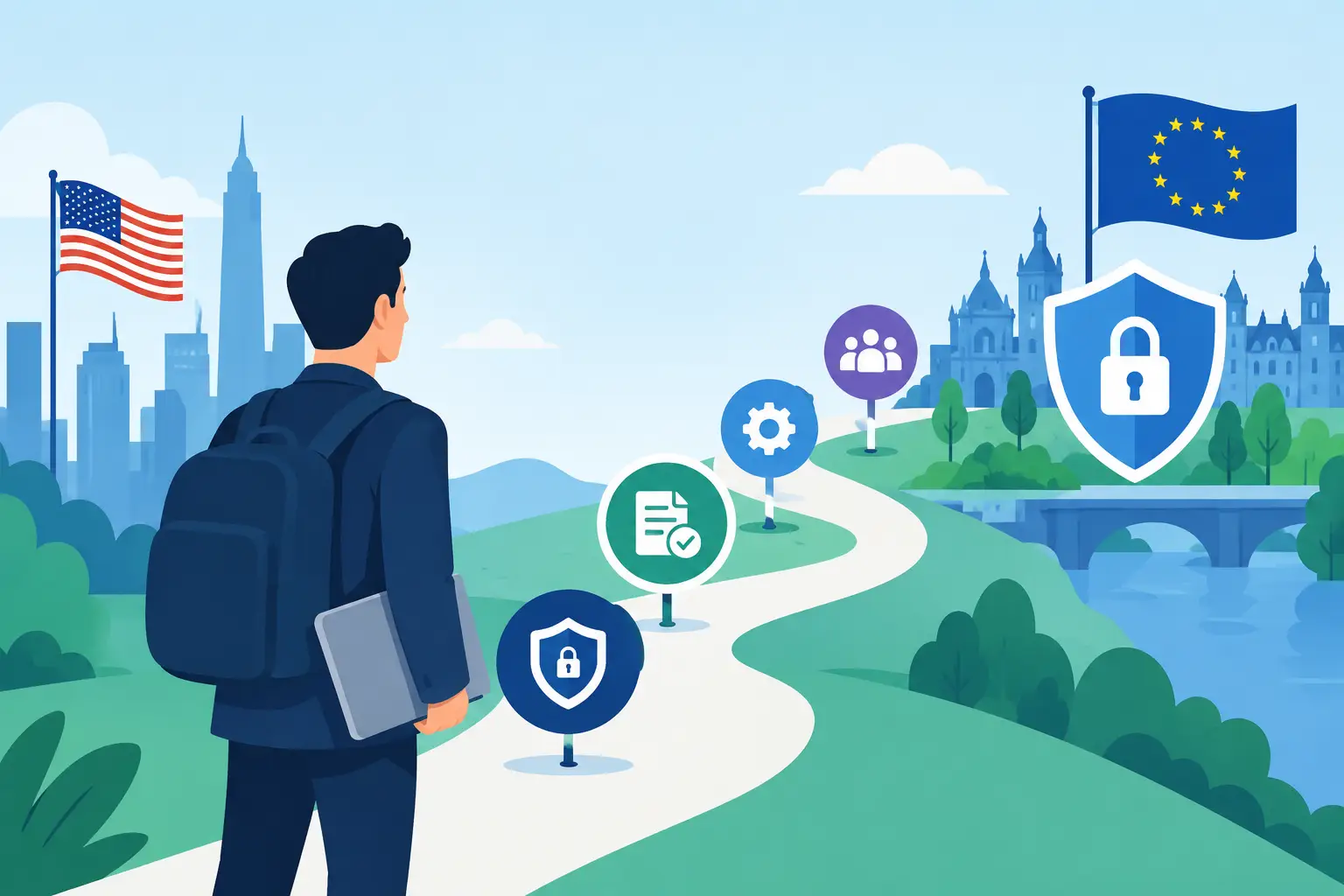
A US startup EU privacy roadmap becomes urgent the moment your product starts collecting data from people in Europe, not when your company opens an office in Paris or signs its first enterprise contract. A free trial from Germany, ad targeting in Spain, or behavior analytics on visitors in Italy can bring the GDPR into scope. The gap between "we are a US company" and actual compliance is where regulatory risk, stalled procurement, and public credibility problems start.
For founders, the goal is not to recreate a European legal department. It is to establish control: know what data you collect, why you collect it, where it goes, who answers when a regulator writes, and what happens when a customer asks to see or delete it.
Start Your US Startup EU Privacy Roadmap With Scope
The GDPR can apply to a company with no EU office or employees. The key question is whether you offer goods or services to people in the EU or monitor their behavior there. Payment is not required. A consumer app, SaaS trial, online store, newsletter, or ad-supported product may be offering services even when it is free.
Monitoring is equally broad in practical terms. It can include behavioral advertising, tracking pixels, device identifiers, analytics tied to identifiable users, profiling, location data, and product analytics used to predict or influence user behavior. Merely having a website visible in Europe is not automatically enough. But EU language options, EU pricing, shipping to EU countries, targeted campaigns, or a product designed for EU users are strong signals that your business is within reach.
Do not let the legal analysis remain a vague founder conversation. Write down your EU touchpoints: countries served, customer types, acquisition channels, data sources, tracking tools, and vendors. That record becomes the starting point for every decision that follows.
Decide Whether Article 27 Applies
If the GDPR applies and your company has no establishment in the EU, Article 27 may require you to appoint an EU Representative. The representative is a formal point of contact in the EU for supervisory authorities and data subjects on matters related to processing. This is not a decorative address for your footer. It is a visible compliance role that must be documented and reflected in your privacy information.
There is a narrow exception for processing that is occasional, unlikely to create risk to individuals, and does not involve large-scale processing of special-category or criminal-conviction data. Startups often overread the word "occasional." An always-on SaaS platform, ecommerce operation, or app processing customer data every day will struggle to describe that activity as occasional.
Article 27 representation does not eliminate the need for a privacy program. It also does not turn the representative into your data protection officer or make the representative responsible for every business decision. It establishes a capable EU-facing channel when authorities or individuals need answers. That distinction matters when selecting a provider. A mailbox service can forward a message. It cannot necessarily assess a regulator's request, organize an appropriate response, or coordinate an incident under pressure.
For US businesses that need formal coverage, rep4eu provides lawyer-led Article 27 representation through licensed German attorneys rather than passive message forwarding.
Build the Data Map Before You Write Policies
Most weak privacy programs begin with a copied privacy policy. That reverses the work. Your public notice is only as accurate as your understanding of the underlying data flows.
Create a practical data inventory. For each product, website, and internal business function, identify the categories of personal data collected, the source, the purpose, the systems where it is stored, the people who can access it, and the retention period. Include the data your team forgets because it lives outside the core product: CRM records, support tickets, billing platforms, recruiting tools, session replay, email marketing, error logs, and spreadsheets.
Then identify your role. In many cases, a SaaS vendor processes its business customer's data as a processor while acting as an independent controller for its own sales, billing, website, account administration, and security data. The role can change by processing activity. A single blanket statement that you are always a processor is usually inaccurate.
This exercise exposes the issues that procurement teams find quickly: unnecessary collection, unknown retention, unauthorized access paths, and vendors with no clear contractual status. It also lets you match each processing purpose to an appropriate GDPR legal basis. Consent is not the default answer. Contract necessity, legitimate interests, legal obligations, and consent have different requirements and different failure modes.
Fix the Public-Facing Layer Early
Once the data map is credible, your external materials can reflect reality. Your privacy notice should explain what you collect, why you process it, relevant legal bases, retention, recipients, international transfers, individual rights, and how EU individuals can contact you and your representative where applicable. Generic language that promises rights without explaining how to exercise them creates its own operational problem.
Cookie and tracking practices need separate attention. The GDPR is not the only concern. EU cookie rules generally require consent before placing nonessential cookies or similar tracking technologies. A banner that loads ad pixels before a visitor makes a choice, or treats continued browsing as consent, is not a defensible implementation.
This is a business decision as much as a legal one. Removing every measurement tool may harm growth visibility. Keeping every tracker may create consent and vendor risk that cannot be explained to a customer. Configure tools by purpose, document the decision, and test the website as a user would.
Make International Transfers Defensible
A US startup may collect EU data in a European cloud region and still transfer data to the United States through support access, engineering access, logging, security monitoring, or a US-based vendor. The question is not simply where the server sits. It is whether personal data is made available outside the European Economic Area.
Your roadmap should identify each transfer and the mechanism supporting it. Depending on the circumstances, this may involve an adequacy decision, an approved transfer framework certification, or standard contractual clauses combined with a transfer assessment and supplementary safeguards. The right path depends on your corporate structure, recipient, data type, and access model.
Avoid the common shortcut of adding standard contractual clauses to every vendor agreement and calling the work finished. The clauses are contractual commitments, not a substitute for understanding what access occurs or whether your technical and organizational measures match the risk. Encryption, access controls, key management, minimization, and documented access procedures are part of the analysis.
Prepare for Requests and Incidents Before They Arrive
EU individuals can request access, deletion, correction, restriction, portability, or object to certain processing. In many cases, the GDPR requires a response within one month. A startup does not need a large privacy operations team to meet that expectation, but it does need an owner, an intake process, identity verification rules, and a way to find data across systems.
Assign responsibility across legal, security, support, and engineering. Support should know not to improvise legal answers. Engineering should know how to export and delete data without damaging other customers' records. Legal or compliance should review exceptions, extensions, and requests that conflict with retention obligations.
The same discipline applies to security incidents. A personal data breach may require notification to the relevant authority within 72 hours after awareness when it is likely to risk individuals' rights and freedoms. That clock does not wait for a perfect forensic report. Your incident plan should establish escalation triggers, decision-makers, evidence preservation, vendor notification paths, and communications approval. A representative can be part of the EU-facing response channel, but your company still needs to make timely, informed decisions.
A Practical 90-Day Sequence
The fastest route is to sequence the work around exposure rather than trying to perfect every document at once.
- In the first 30 days, determine GDPR and Article 27 applicability, appoint responsible owners, map core data flows, inventory vendors, and stop obvious tracking or access practices you cannot justify.
- By day 60, update privacy disclosures, establish request and incident workflows, execute the necessary processor terms, and document international transfer mechanisms.
- By day 90, test a data subject request and a breach escalation, review high-risk processing, set retention rules, and prepare evidence for customer security or procurement reviews.
If your product handles sensitive data, conducts large-scale tracking, makes automated decisions with significant effects, or processes data about children, move the risk assessment forward. Those facts may require a deeper review, including whether a data protection impact assessment is necessary. The right roadmap depends on what your company actually does, not its headcount or funding stage.
A credible EU privacy program is not the longest policy in your data room. It is the ability to show, when a customer, individual, or authority asks, that someone knows the facts, owns the response, and can act before the deadline becomes the problem.