

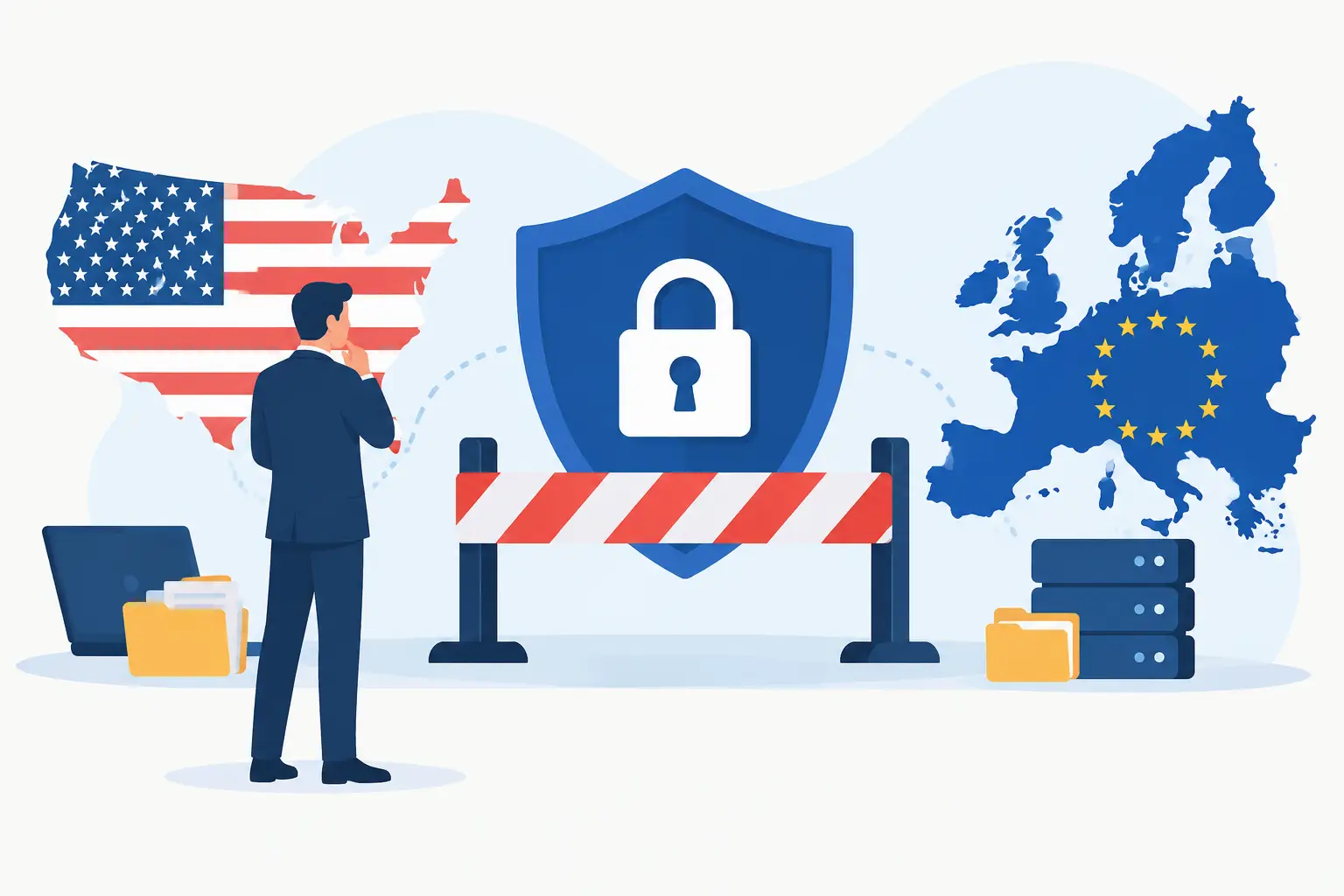
A US company can have a polished privacy policy, a respected security program, and a European sales pipeline - then still be visibly noncompliant on the details regulators and enterprise buyers check first. The top GDPR compliance blockers are rarely obscure legal issues. They are operational gaps: no clear ownership, no credible EU contact point, unclear data flows, and a response process that breaks when a real request arrives.
For companies outside the EU, those gaps can delay procurement, invite complaints, and create unnecessary exposure across 27 member states. The practical question is not whether your privacy materials look complete. It is whether your business can prove who is responsible, respond on time, and handle an inquiry without improvising.
1. Treating GDPR as a policy exercise
Many teams begin and end with a privacy notice. They borrow language from a competitor, add a cookie banner, and assume the foundation is covered. That approach fails because a notice is a statement about operations, not a substitute for them.
If the notice says individuals can access, delete, correct, or object to processing, the company needs a process that can identify the person, locate relevant systems, assess exceptions, and respond within the required timeframe. If it says data is shared with service providers, the vendor list and contractual arrangements need to support that statement. If the document promises safeguards for international transfers, those safeguards cannot exist only in a template folder.
The blocker is usually not bad intent. It is the disconnect between legal language and the people, systems, and decisions behind it. Fix the operating model first, then make the privacy notice accurately reflect it.
2. Misreading Article 27 applicability
Article 27 is one of the most common blind spots for non-EU businesses. A company does not need an office, employees, or a subsidiary in Europe to fall within the GDPR's territorial reach. Offering goods or services to people in the EU, or monitoring their behavior, can be enough depending on the facts.
When Article 27 applies, the organization generally must designate an EU Representative in writing. The representative serves as a contact point for supervisory authorities and data subjects on matters related to GDPR processing. Simply listing a US headquarters address, a generic inbox, or a European reseller does not automatically satisfy this requirement.
There are limited exceptions, including for certain occasional, low-risk processing that is unlikely to affect individuals' rights and freedoms. But this is not a safe assumption for a SaaS platform with EU users, an ecommerce brand shipping into Europe, an app using analytics, or an ad-tech business tracking behavior. Recurring commercial processing is difficult to characterize as occasional.
The commercial impact is immediate. EU customers and procurement teams increasingly ask for an Article 27 representative before signing. A missing designation can turn into a stalled deal, a failed questionnaire, or a public compliance weakness.
3. Choosing a mailbox instead of a legal response capability
Not every EU Representative service offers the same protection. A low-cost provider may provide an address, forward messages, and leave your team to determine what a regulator's letter means, who should answer, and whether the response creates additional risk.
That is not representation in the practical sense. It is message routing.
A serious EU Representative arrangement should be able to receive authority correspondence, triage data subject requests, coordinate the right internal stakeholders, and provide legally informed guidance on the next step. This matters most when the request is urgent, incomplete, or adversarial. The difference between forwarding an inquiry and managing a response can determine whether a manageable question becomes an avoidable enforcement problem.
For non-EU companies, the representative also needs to be credible on paper. Buyers and regulators may look at the designation itself, the provider's legal standing, and whether there is a real professional team behind the contact details. A passive address can create the appearance of compliance without delivering the protection the role is meant to provide.
4. Not knowing where EU personal data actually goes
The GDPR does not require a company to create a perfect diagram of every byte in real time. It does require a defensible understanding of the personal data it collects, why it uses it, where it stores it, who receives it, and how long it keeps it.
This becomes difficult quickly. A typical US software company may collect account information in its application, usage data through analytics tools, support tickets in a help desk platform, payment information through a processor, and lead data through a CRM. Each platform can introduce sub-processors, transfers, retention settings, and security dependencies.
Without a current data map, teams cannot reliably answer basic questions: Is this request within scope? Which vendors need to be searched? Are we collecting more data than necessary? Did a new tool introduce a transfer issue? The result is slow responses and inconsistent statements to customers.
Start with the highest-risk processing: customer accounts, marketing leads, employee or applicant data, behavioral analytics, location data, and sensitive data. Identify the business owner for each flow, the systems involved, the legal basis relied on, retention expectations, and recipient categories. A workable map that is reviewed after material changes is more useful than an elaborate inventory no one maintains.
5. Weak data subject request handling
A single access or deletion request can expose several failures at once. Requests arrive through support channels, social media, sales inboxes, or the designated representative. If frontline staff do not recognize them, deadlines start running before privacy or legal teams are involved.
The response process needs clear ownership and a usable decision path. Someone must verify identity proportionately, determine which systems need to be searched, assess whether an exemption applies, coordinate vendor involvement, and communicate the outcome clearly. Under the GDPR, organizations generally must respond without undue delay and within one month, subject to limited extension rules.
Over-verification creates friction and may discourage legitimate requests. Under-verification can disclose data to the wrong person. The right approach depends on the sensitivity of the data and the risk of impersonation. A request to delete a marketing email address is not the same as a request for account records containing financial or health-related information.
Test the process before it is needed. Run a sample access request and deletion request through the actual systems your team uses. Measure where it stalls. The weakest step is often not legal analysis. It is finding an owner who can export, correct, or delete data from a tool purchased years ago.
6. Vendor management that stops at the contract
A signed data processing agreement is necessary in many vendor relationships, but it is not the end of vendor due diligence. The company still needs to know what the provider does, whether it is authorized to process the relevant data, how it handles security incidents, and whether international transfers are addressed.
This is especially relevant for rapidly growing companies. Marketing, product, and operations teams can add tools faster than legal or privacy teams can review them. A new session-replay platform, AI customer support tool, or analytics product may process more personal data than stakeholders realize.
Build a practical intake gate for new vendors and material changes. It does not need to slow down every purchase. It should flag tools that process customer, prospect, employee, or sensitive information; use data for their own purposes; rely on sub-processors; or transfer data outside the EU. Those are the decisions that deserve documented review.
7. Treating incident readiness as an IT-only problem
A security incident is not automatically a GDPR personal data breach, and not every breach requires notification. But waiting to involve privacy and legal teams until after technical containment is complete can make the assessment harder and compress an already demanding timeline.
The GDPR may require notification to the relevant supervisory authority within 72 hours after awareness of a qualifying breach. The analysis depends on the facts: what data was involved, whose data was affected, whether it was accessed or merely unavailable, what safeguards existed, and what risk the event presents to individuals.
Your incident plan should identify who makes the legal assessment, who preserves facts, who communicates with vendors, and who can contact the EU Representative immediately. It should also define escalation criteria for ransomware, lost devices, misdirected emails, credential compromise, unauthorized access, and vendor incidents. A technically contained event can still require a carefully documented legal decision.
Turn compliance blockers into a response-ready operating model
The fastest path is not to launch a massive privacy project. It is to close the gaps that make your company unable to answer basic scrutiny: confirm GDPR and Article 27 exposure, appoint a credible EU Representative where required, map priority data flows, establish request handling, and rehearse incident escalation.
For companies that need Article 27 coverage, rep4eu provides lawyer-led EU representation rather than a passive mailbox. That distinction matters when an authority, customer, or data subject expects a real response.
Compliance becomes commercially useful when it can withstand contact from the outside. Build for that moment before a regulator, procurement team, or customer forces the issue.