

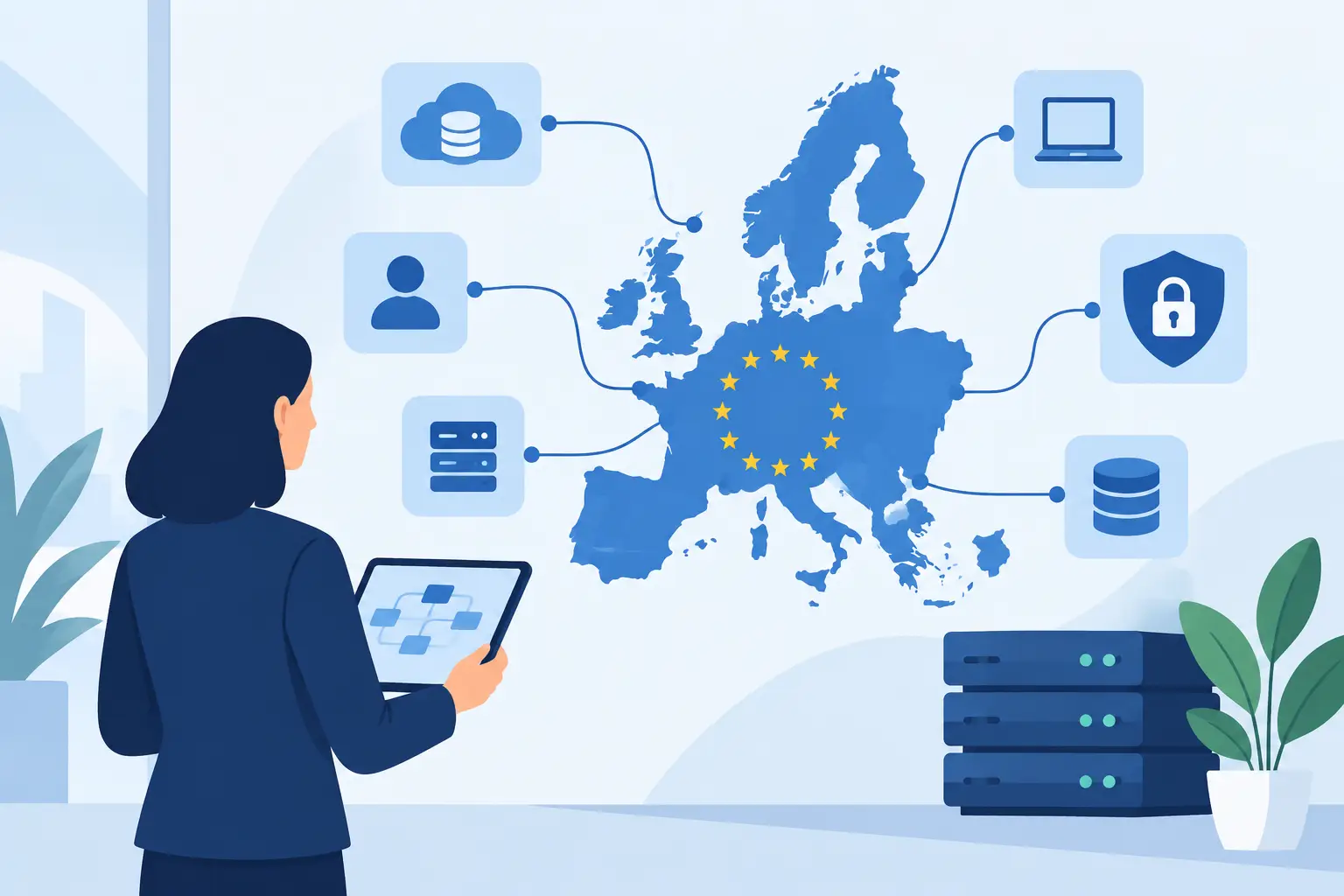
A US SaaS company may know it has European customers but still be unable to answer a regulator's first practical question: where does an EU user's data actually go? To map EU data processing is to turn that uncertainty into an accountable record of collection, access, storage, sharing, and deletion. It is not a paperwork exercise. It is the foundation for deciding whether the GDPR applies, whether Article 27 representation is required, and whether your public privacy claims match your operations.
The problem usually surfaces at the worst moment: a large EU prospect sends a privacy questionnaire, a user submits an access request, a vendor reports an incident, or a supervisory authority asks who represents the company in Europe. At that point, a disconnected list of tools and a generic privacy policy will not carry much weight.
Why Map EU Data Processing First
Most non-EU businesses process EU personal data through more systems than they realize. A visitor completes a demo form. Analytics records device identifiers. A CRM assigns a sales owner. Support software stores the conversation. A payment processor receives billing information. Product logs capture behavior, and a cloud provider may replicate it across regions.
Each step can involve a different purpose, data category, recipient, transfer mechanism, retention period, and legal responsibility. Without a map, teams tend to give incomplete answers, overstate controls, or miss processing that contradicts the privacy notice. Those failures create more than legal risk. They delay procurement reviews and make an otherwise credible company look unprepared.
A useful map also prevents a common mistake: treating the location of the company as the decisive issue. A business headquartered in California may have no EU office and still fall within the GDPR's territorial scope if it offers goods or services to people in the EU or monitors their behavior. The facts matter - not the mailing address on the incorporation documents.
What a Defensible Data Map Must Show
A spreadsheet can be sufficient at the start. What matters is whether it gives legal, security, product, and commercial teams a reliable view of the same reality. Do not begin by cataloging every software subscription. Begin with the data lifecycle.
For each processing activity, document the business purpose, the people concerned, the data collected, where it came from, which internal teams can access it, and which external providers receive it. Then identify storage locations, international transfers, retention rules, and the technical or organizational controls that apply.
For example, "customer support" is not a complete processing activity. A usable entry explains that support staff process names, contact details, account identifiers, messages, attachments, and possibly sensitive information submitted by customers. It identifies the ticketing vendor, whether agents work from the United States or other countries, how long tickets remain available, and how deletion requests are handled.
Separate Customers, Prospects, and Users
Do not assume all EU data is processed in the same way. A B2B prospect who downloads a report, an administrator who signs a contract, an end user of a customer account, and a mobile-app visitor may enter your systems through different paths and have different expectations.
This distinction changes the analysis. Marketing data may rely on one operational workflow, product account data on another, and employee or applicant data on yet another. Combining them into one vague category such as "contact information" makes it harder to assess notice obligations, retention, opt-outs, access requests, and data sharing.
Follow the Data Beyond Your Product
The map must include vendors, sub-processors, affiliates, contractors, and internal collaboration tools. Data often leaves the core product quickly. It may flow to a cloud host, error-monitoring platform, email provider, fraud tool, communications service, analytics platform, and outsourced support team.
This is where teams discover the gap between contract language and actual use. A vendor may be approved for one purpose but configured to receive event data it does not need. A developer may export production data to troubleshoot an issue. A sales tool may retain prospect data long after the campaign ends. Mapping exposes these practices early enough to correct them.
Use the Map to Test GDPR and Article 27 Exposure
Once the flow is visible, assess whether the GDPR applies to the relevant activity. Selling into the EU is not automatically enough, and a single incidental interaction may not establish a pattern of targeting. But pricing in euros, shipping to EU countries, running campaigns aimed at EU audiences, offering localized language options, or tracking EU users' behavior are facts that deserve serious review.
If your company has no establishment in the EU but is subject to the GDPR under its territorial scope, Article 27 may require you to appoint an EU Representative. Limited exemptions exist, including for genuinely occasional, low-risk processing that does not involve large-scale processing of special categories of data or criminal-offense data. These exemptions are narrow in practice and should not be treated as a default answer for a growing SaaS, ecommerce, app, or ad-supported business.
Your data map supplies the evidence for that decision. It shows whether processing is ongoing, how many EU individuals are affected, whether behavioral data is involved, and whether sensitive categories could enter the environment. It also identifies the authorities and countries most likely to be relevant if a complaint or inquiry arrives.
An EU Representative is not a substitute for a lawful data program. It does not repair weak vendor controls, create a legal basis, or erase a breach. It provides an established EU-facing point of contact and helps ensure that regulator communications and qualifying data subject requests receive a substantive, coordinated response rather than disappearing into an unattended mailbox.
Turn the Map Into an Operating Record
A map that is created once and ignored will fail when the business changes. The practical goal is an operating record connected to product releases, vendor onboarding, marketing launches, and incident response.
Assign a clear owner for each processing activity. In a smaller company, that may be a privacy lead working with engineering, security, sales, and operations. In a larger company, owners may sit with business units, while legal or privacy maintains standards and review controls. The ownership model matters less than the ability to confirm facts quickly.
Use a simple change trigger: update the map before launching a new feature that collects data, adding a vendor, entering a new market, changing retention settings, deploying new tracking technology, or allowing a new group of staff to access customer information. Waiting for an annual compliance review is too slow for most product organizations.
The record should also support real response scenarios. When an EU user asks for access or deletion, can your team identify every system that holds relevant data? When a vendor has an incident, can you determine which EU individuals may be affected? When a customer asks where data is processed, can sales provide an answer approved by legal and security?
If the answer is no, the map is incomplete - or it exists only as a compliance artifact rather than a business tool.
The Common Shortcuts That Create Exposure
Three shortcuts repeatedly cause trouble. The first is mapping only production databases. Personal data also lives in support systems, CRM platforms, log files, backup environments, shared drives, and employee devices. The second is accepting a vendor inventory as a data-flow map. An inventory names providers; a map explains what data moves, why it moves, and who can act on it.
The third is copying retention periods from a template. Retention must reflect business needs, contractual obligations, security requirements, and legal duties. Keeping everything forever is not a defensible strategy, but deleting information too quickly can impair fraud prevention, dispute handling, or legal claims. The right period depends on the data and purpose, and it should be consistently applied.
There is also a commercial shortcut: appointing a passive address provider and assuming the issue is resolved. Article 27 is a legal representation requirement, not a mail-forwarding exercise. If an authority contacts your representative, you need a party able to recognize urgency, coordinate the facts, and respond appropriately. Lawyer-led coverage such as rep4eu is designed for that operational reality.
Start With the Flows You Cannot Afford to Misstate
Do not wait for a perfect enterprise governance project. Start with the routes that create the most exposure: website and app collection, customer onboarding, product telemetry, marketing automation, support, payments, and core vendors. Validate each route with the people who configure the tools, not only the people who signed the contract.
Then use what you find to close the obvious gaps: revise notices that no longer reflect practice, restrict unnecessary access, document transfer arrangements, set workable deletion rules, and determine whether Article 27 representation is required. The map is valuable because it replaces assumptions with evidence.
The next EU customer questionnaire, access request, or authority inquiry should not force your team to reconstruct its data practices under pressure. Build the record while you still have time to make decisions instead of explanations.