

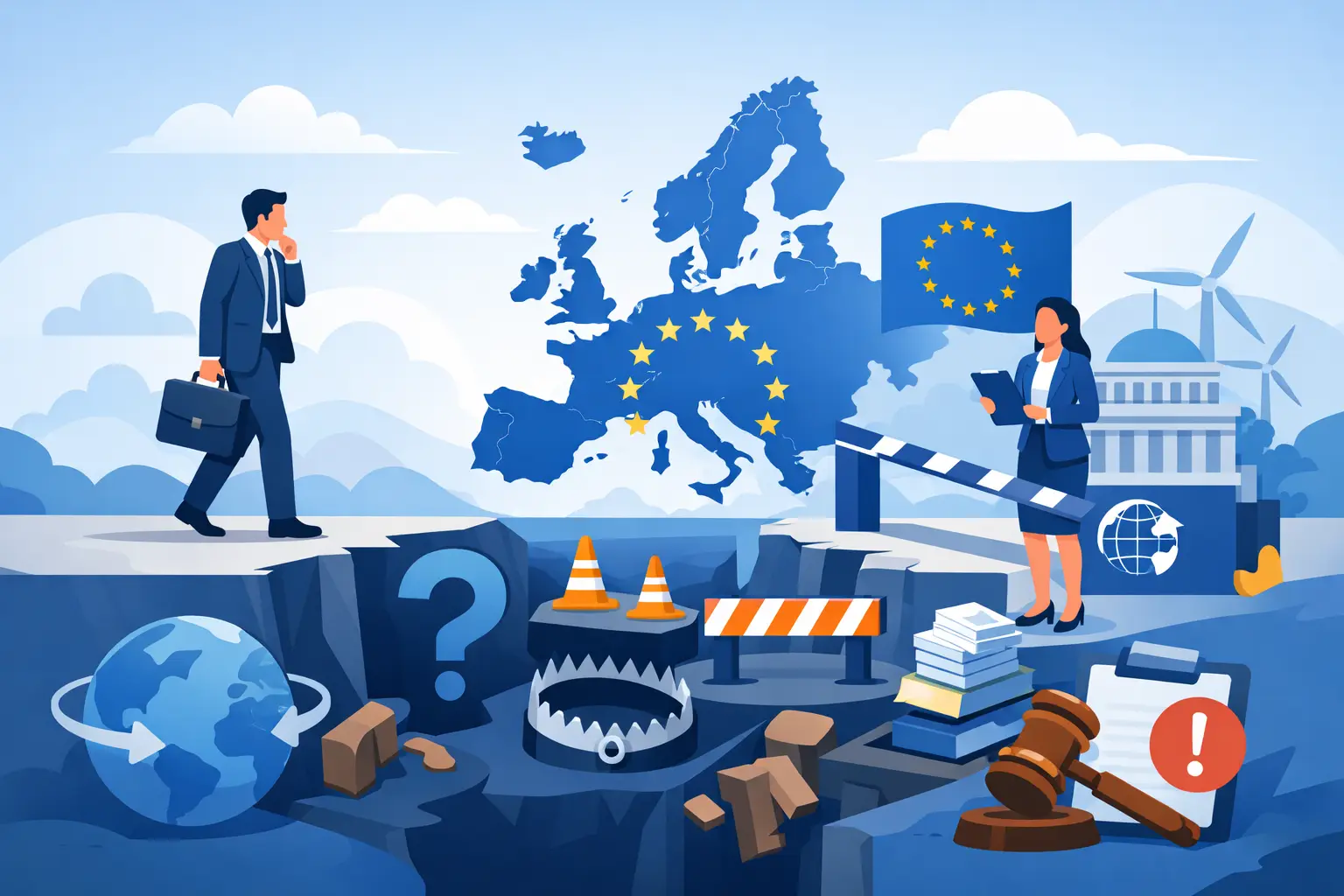
A missing EU representative is not a minor website defect. For a US SaaS company, app, retailer, or data platform serving people in Europe, it can become the visible proof that the business has not taken its GDPR obligations seriously. The top Article 27 mistakes usually begin with a false assumption: that a company outside the EU is outside EU enforcement.
That is not how the GDPR works. If your company offers goods or services to people in the EU or monitors their behavior, GDPR Article 3(2) may apply even when your headquarters, employees, servers, and bank account are all outside Europe. Article 27 can then require a written designation of an EU-based representative. The representative must be equipped to deal with regulators and data subjects, not merely receive mail.
The Top Article 27 Mistakes That Create Exposure
1. Assuming a US company is beyond GDPR reach
Many companies assess GDPR exposure based on where they are incorporated. The better question is what they do with people in the EU. A US company that ships products to France, runs German-language campaigns, accepts euros, or tracks EU visitors for behavioral advertising may be caught by the GDPR's extraterritorial scope.
A generic English-language website alone does not automatically mean you target the EU. Context matters. But waiting for a complaint before analyzing the facts is a poor business strategy, especially when enterprise customers and procurement teams are already asking compliance questions.
2. Treating Article 27 as optional because processing is "occasional"
Article 27 contains a narrow exception for certain occasional processing that is unlikely to create risk and does not involve large-scale processing of special category data or criminal-offense data. Companies often read the word "occasional" and stop there.
That is a mistake. A subscription platform continuously collecting account data, support tickets, usage analytics, marketing preferences, and device identifiers is not operating on an occasional basis. Neither is an eCommerce business regularly selling to EU consumers. The exception is fact-specific, and it should not be used as a convenient excuse to avoid appointing a representative.
3. Appointing a mailbox service instead of a capable representative
A mailbox can receive an envelope. It cannot assess a regulator's request, identify a missed deadline, coordinate a legal response, or help route a complex data subject access request to the correct team.
Article 27 requires a representative that can be addressed by supervisory authorities and data subjects on matters related to GDPR processing. A low-cost forwarding address may look adequate until an authority asks targeted questions about legal basis, retention, transfers, security measures, or a reported incident. At that point, forwarding alone can leave your business exposed and scrambling.
4. Failing to put the designation in writing
An informal arrangement with a European consultant, distributor, or friend does not create a defensible Article 27 appointment. The designation must be in writing, and the parties need clarity on responsibilities, communication channels, escalation rules, and authority to receive requests.
This documentation matters during due diligence as much as during enforcement. If a customer asks for proof of your representative arrangement, a vague email chain will not inspire confidence. A signed designation is basic compliance hygiene.
5. Listing the wrong contact details in the privacy notice
Where Article 27 applies, the identity and contact details of the EU representative should be available in the privacy information provided to affected individuals. Businesses commonly appoint a representative but forget to update their privacy notice, product pages, mobile-app disclosures, and relevant intake forms.
That creates an avoidable contradiction. Your internal records say you have addressed the requirement, while your public-facing notice tells users and regulators otherwise. Review every privacy notice version and every customer-facing property where the notice appears.
6. Choosing a representative in the wrong location
The representative must be established in one of the EU member states where the relevant data subjects are located. This does not mean a company needs representatives in all 27 member states. It does mean the location should be selected with the actual scope of your EU activities in mind.
For a business serving customers across multiple EU markets, a representative established in Germany may be a practical choice. But the decision should follow your data map, market footprint, and processing activities, not the cheapest address available online.
7. Confusing an EU representative with a DPO
An EU representative and a data protection officer perform different functions. A DPO has independent statutory duties and may be mandatory in specific cases. An Article 27 representative is a local point of contact for regulators and individuals when a non-EU controller or processor falls within the GDPR's extraterritorial scope.
Appointing one does not automatically satisfy the obligations of the other. It also does not erase the need for privacy governance, lawful processing, vendor controls, or incident readiness. A representative is part of the compliance structure, not a substitute for it.
8. Giving the representative no operational context
Even a qualified representative cannot protect a company that refuses to provide the information needed to respond. The representative should understand your products, entities, decision-makers, data categories, processing purposes, key vendors, transfer arrangements, and incident escalation process.
This does not require handing over every internal document on day one. It does require a controlled, current readiness file and a clear route to the people who can answer questions. If a supervisory authority contacts your representative on Friday, your team cannot spend the following week trying to identify who owns privacy operations.
9. Letting data subject requests sit in an inbox
Access, deletion, objection, and portability requests have statutory timing requirements. The precise response depends on the request and the circumstances, but delay is rarely defensible when the request was received at a published contact point and simply was not routed internally.
The practical fix is simple: define intake, verification, triage, ownership, and escalation before requests arrive. Your EU representative should know where to send a request, who acknowledges it, and who makes the final decision. A real response process is more valuable than a generic promise in a privacy policy.
10. Assuming the representative takes your liability
Article 27 representation does not transfer the controller's or processor's GDPR obligations to the representative. Your company remains responsible for the underlying processing decisions, notices, contracts, security measures, and legal bases.
This is precisely why the representative relationship should be substantive. You need a partner that can help you receive, assess, and coordinate external communications while keeping responsibility clear. A provider that promises to make compliance disappear is selling the wrong thing.
11. Ignoring Article 27 until a deal is blocked
EU customers increasingly assess privacy maturity before signing. Procurement questionnaires often ask whether a non-EU supplier has appointed an EU representative, and a missing answer can stall a sale that took months to develop.
The cost of arranging representation after a red flag appears is not only the subscription fee. It includes delayed contracting, emergency internal reviews, revised notices, rushed legal decisions, and lost confidence. Addressing the requirement before a buyer, regulator, or complainant finds the gap gives your business room to act deliberately.
12. Treating a security incident as separate from representation
A cross-border incident creates immediate pressure: technical containment, legal assessment, customer communications, possible notification duties, and likely questions from stakeholders. If EU personal data is involved, the EU representative may become an essential contact point for authority communications.
Do not wait for an incident to decide who can speak to whom. Test the escalation path. Confirm that your representative can reach the right internal contacts, that outside counsel knows the arrangement, and that decision-makers understand the relevant notification deadlines.
A Practical Article 27 Readiness Check
A defensible setup begins with a direct scope assessment. Identify whether you offer goods or services to people in the EU, monitor their behavior, or otherwise process their data in a way that triggers GDPR Article 3(2). Then determine whether the narrow Article 27 exception genuinely applies to your actual processing, not an idealized description of it.
If representation is required, appoint an EU-based representative in writing and publish accurate contact information in the appropriate privacy notices. Build an operating process around the appointment: designate internal owners, create secure request-routing channels, preserve relevant processing records, and establish escalation procedures for regulator outreach and incidents.
The provider choice matters. A passive address may meet a superficial checkbox, but it can create a serious operational weakness when the first difficult request arrives. Lawyer-led representation gives your company someone who can recognize legal risk, coordinate a measured response, and keep a routine inquiry from becoming a self-inflicted compliance failure. That is the standard rep4eu is built to provide.
The useful question is not whether Article 27 is inconvenient. It is whether your company can credibly answer when an EU customer, data subject, or regulator asks who represents you in Europe - and what that representative can actually do.