

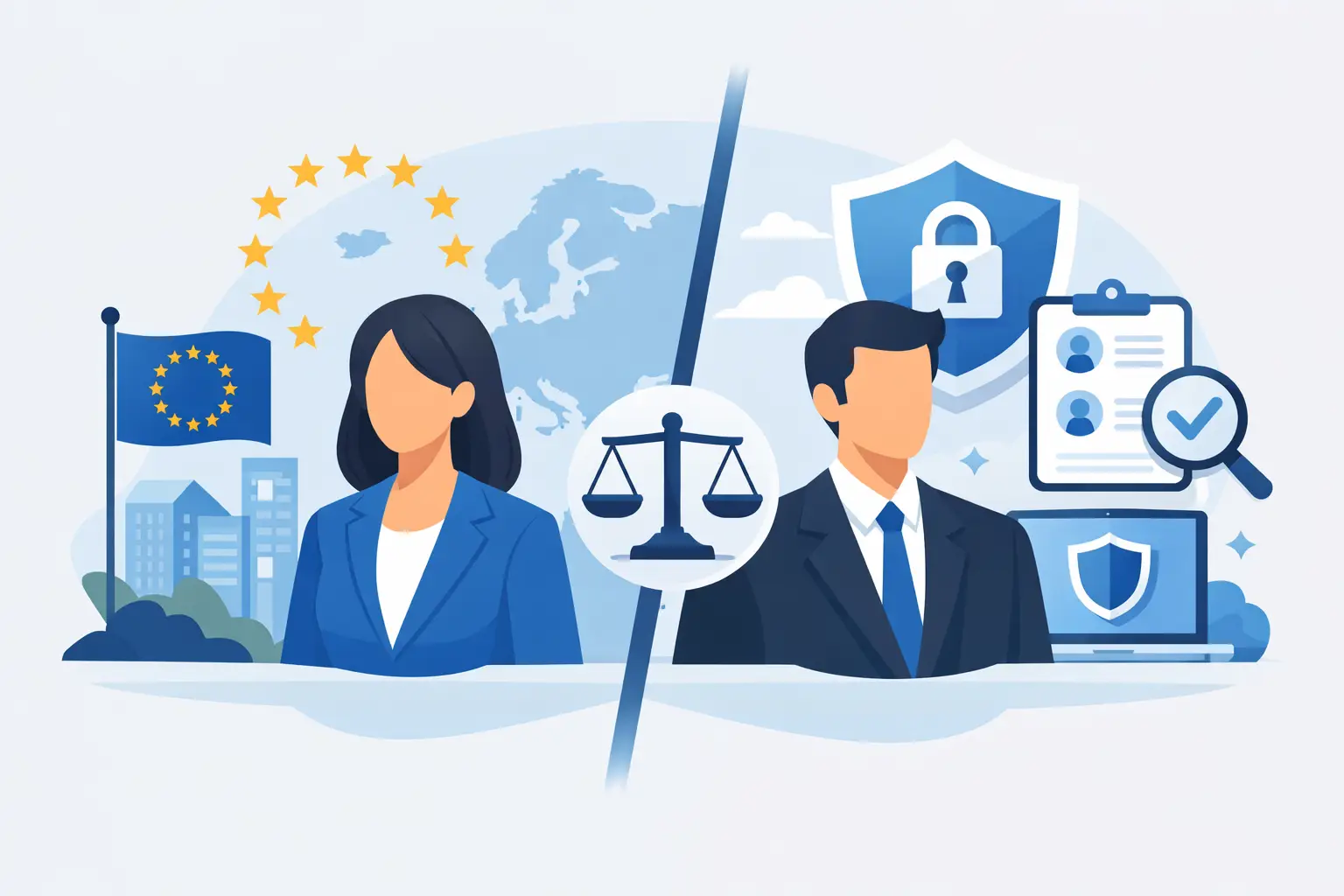
A surprising number of US companies think appointing a DPO solves their EU exposure. It does not. In the EU representative vs DPO question, the biggest mistake is assuming these roles are interchangeable. They are not. One exists mainly because you process personal data in ways that trigger GDPR governance obligations. The other exists because you are outside the EU but still target or monitor people in the EU.
That distinction matters fast when a regulator sends a notice, a procurement team asks for your Article 27 details, or a data subject wants to know where to direct a rights request. If you pick the wrong role, or skip the one you actually need, you create visible non-compliance.
EU representative vs DPO: the core difference
An EU Representative is required under GDPR Article 27 for many companies that are not established in the EU but offer goods or services to people in the EU, or monitor their behavior there. The representative acts as your local point of contact in the Union for supervisory authorities and data subjects on issues related to GDPR processing.
A Data Protection Officer, or DPO, is a different role under Articles 37 to 39. A DPO is appointed when your processing activities meet certain thresholds, such as large-scale monitoring or large-scale processing of special category data. The DPO advises on compliance, monitors internal privacy practices, and must operate with a degree of independence.
So the short version is simple. The EU Representative is about your external presence in the EU when you have no establishment there. The DPO is about internal privacy oversight when your processing profile requires it.
Why non-EU companies confuse the two
The confusion usually starts because both roles appear in GDPR materials, both can be listed in privacy notices, and both deal with regulators and data subjects. From a distance, they look similar. Operationally, they are not.
A representative is not your internal privacy strategist. A DPO is not your Article 27 stand-in. One cannot casually replace the other just because the job titles sound adjacent. GDPR is explicit on this point. In some cases, a company may need both. In other cases, it may need only one. And many non-EU businesses that clearly need an EU Representative do not need a DPO at all.
That is where businesses lose time. They over-engineer the wrong compliance function while leaving the visible Article 27 gap open.
What an EU Representative actually does
For a non-EU business, the EU Representative is not a ceremonial address line. At least, it should not be. The role is supposed to be a functioning point of contact for supervisory authorities and data subjects in relation to your GDPR obligations.
In practice, that means formal designation in writing, inclusion in your privacy notice, handling incoming authority communications, receiving data subject correspondence, and helping route those issues to the right internal teams quickly. If there is a complaint, inquiry, or enforcement touchpoint, the representative is part of the front line.
This is why a mailbox-only provider creates risk. If your provider simply forwards messages with no legal triage, no context, and no response discipline, you still carry the operational burden at the worst possible moment. The role exists to reduce regulatory friction, not just to satisfy a line item.
What a DPO actually does
A DPO serves a different function. The DPO informs and advises the organization on GDPR obligations, monitors compliance, supports data protection impact assessments, and acts as a contact point for regulators on matters related to processing.
But the DPO is not there because you are outside the EU. The DPO is there because the nature, scale, and sensitivity of your processing require structured privacy oversight. Many companies assume having a privacy lead, security leader, or outside counsel means they already have a DPO. That is not always true. The DPO role has specific legal expectations, including independence and avoidance of conflicts of interest.
For example, your head of marketing or CTO may understand your data environment well, but that does not automatically make them an appropriate DPO if they determine the purposes and means of processing.
When you need an EU Representative
If your company is based in the US or another non-EU country, has no establishment in the EU, and still sells to, markets to, or monitors people in the EU, Article 27 should be on your radar immediately.
Common trigger scenarios include running an ecommerce store that ships to EU countries, offering a SaaS platform to EU users, localizing ads for EU markets, accepting payments in euros, providing app services to EU residents, or using behavioral analytics and tracking technologies on EU visitors.
There are narrow exceptions, but many commercial businesses relying on recurring customer data, product analytics, or digital marketing do not fit comfortably within them. If GDPR applies extraterritorially to your business and you lack an EU establishment, the default question is not whether Article 27 feels convenient. It is whether you have already left a visible requirement unmet.
When you need a DPO
You do not appoint a DPO just because GDPR applies to you. The requirement usually turns on the type and scale of your processing.
If your core activities involve regular and systematic monitoring of individuals on a large scale, a DPO may be required. The same is true if your core activities involve large-scale processing of special category data, such as health data, biometric data, or other sensitive categories. Public authorities also face DPO obligations, though that is less relevant for most US commercial operators.
This means a B2B software company with a modest EU customer base may need an EU Representative but not a DPO. A digital health platform serving EU patients at scale may need both. A small business with occasional EU orders and limited data processing may need to analyze whether Article 27 applies and may well conclude a DPO is not required.
It depends on facts, not labels.
Can one person or provider do both?
Sometimes companies try to simplify the problem by asking whether the same person can be both the EU Representative and the DPO. In theory, overlap is discussed in some contexts. In practice, it is often a bad compliance design, especially if it blurs the independence expected of the DPO or creates confusion about which function is being performed.
More importantly, combining the roles does not erase the need to satisfy each set of requirements separately. If you need an EU Representative, you need proper Article 27 designation. If you need a DPO, you need a person or service structured to fulfill that role correctly.
For most non-EU businesses, the first urgent issue is more basic. They need to stop treating Article 27 like an optional mailing address.
The business risk of getting this wrong
This is not just a legal theory problem. The wrong answer to the EU representative vs DPO question shows up in real operations.
It shows up when an enterprise customer reviews your privacy documentation and notices there is no EU Representative listed despite obvious EU market activity. It shows up when your privacy notice names a DPO but says nothing about Article 27. It shows up when a regulator or data subject reaches out and your supposed representative cannot do more than forward an email into a generic inbox.
That creates friction in deals, weakens trust, and makes your compliance posture look improvised. For growth-stage businesses trying to sell into Europe, those signals matter. Buyers do not want to educate vendors on their own GDPR gaps.
A practical way to decide
Start with two separate questions. First, are you a non-EU company with no EU establishment that still targets or monitors people in the EU? If yes, assess Article 27 immediately. Second, do your core processing activities trigger DPO requirements because of scale, sensitivity, or ongoing monitoring? If yes, assess the DPO obligation separately.
Do not bundle the analysis just because both roles live under GDPR. They solve different problems.
And if you need an EU Representative, choose one that can actually operate under pressure. A lawyer-led service such as rep4eu is built for that reality - not just to receive messages, but to help manage authority contact, data subject requests, and regulatory readiness in a way that protects the business.
The right compliance structure is rarely the one with the fewest titles. It is the one that matches your actual exposure before someone else points out the gap.