

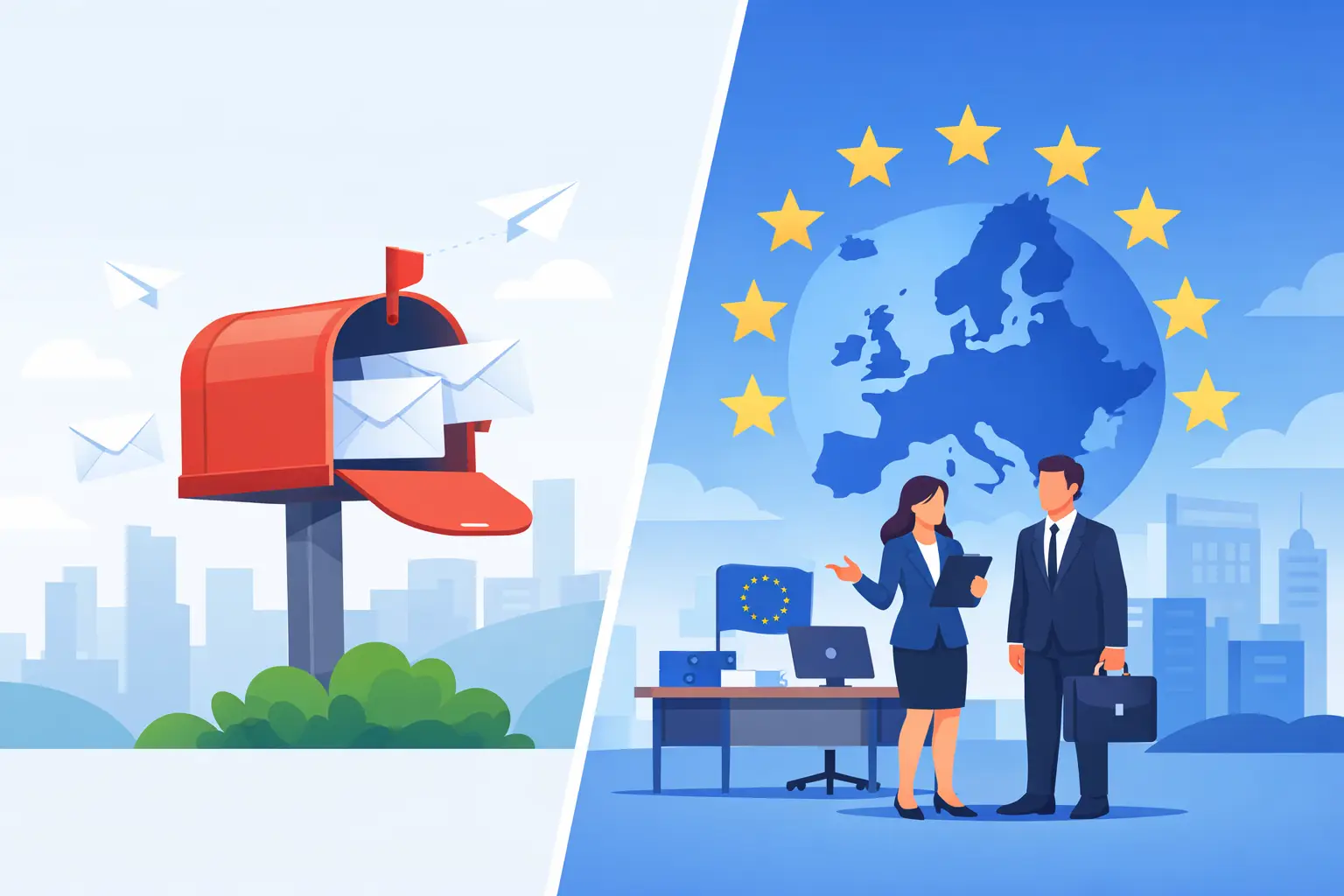
A lot of non-EU companies realize they need Article 27 support only when procurement asks for it, a regulator letter arrives, or a privacy request sits unanswered. That is where the mailbox vs EU representative service question stops being academic. If your business targets people in the EU, the difference can affect enforcement exposure, customer trust, and how fast your team can respond when something goes wrong.
Why mailbox vs EU representative service matters
Article 27 is not a mailing-address rule. It requires certain non-EU controllers and processors to designate a representative in the Union when they fall under the GDPR. That representative is meant to act as a point of contact for supervisory authorities and data subjects on issues related to processing.
That sounds simple until you ask what happens after the message arrives. A mailbox provider can receive correspondence and pass it along. A real EU representative service should be able to interpret what landed, understand the legal stakes, coordinate a response, and keep the issue from getting worse through delay, confusion, or careless handling.
For a US SaaS company, ecommerce brand, app business, or B2B vendor, that difference matters immediately. A regulator does not care that your internal team was busy, that your founder was traveling, or that the message got buried in a shared inbox. If the listed representative is passive, the risk stays with you.
What a mailbox service actually does
A mailbox service is usually exactly what it sounds like - an address and a forwarding function. You get an EU location to list in your privacy notice, and incoming mail is sent on to you.
In the lowest-cost versions, that is the whole product. No legal analysis. No triage. No accountability for whether a regulator inquiry is urgent, whether a data subject request has deadlines attached, or whether the content of the communication reveals a wider compliance problem.
That model can look attractive because it is cheap and easy to buy. For companies under pressure to check the Article 27 box fast, a mailbox feels like a shortcut. The problem is that it solves the visible part of the issue, not the operational part.
If all you need is a street address, a mailbox is enough. If you need someone to stand between your business and a legal process, it is not.
What an EU representative service should do
A proper EU representative service is not just an address provider. It is a designated legal contact function tied to GDPR obligations.
At minimum, the service should formally accept appointment, provide designation documentation, receive authority and data subject communications, and route them in a controlled way. More importantly, it should know what those communications mean. A complaint from a supervisory authority is not ordinary business mail. A request tied to access, deletion, or objection rights is not customer support noise. A security incident with EU data can trigger immediate coordination needs.
This is where lawyer-led representation changes the value of the service. Instead of simple forwarding, you get triage, issue spotting, and response discipline. That does not mean the representative replaces your internal counsel or privacy team. It means the first line of contact is capable, credible, and less likely to mishandle a sensitive event.
The legal and business gap between the two
The mailbox vs EU representative service decision usually comes down to one hard question: are you buying appearance or response capability?
A mailbox helps you look compliant on paper. An EU representative service helps you function under scrutiny. Those are not the same thing.
The legal gap is obvious once you read Article 27 in context. The representative is there to be addressed by authorities and data subjects on all issues related to processing. That role implies more than physical receipt. It requires a contact point that can operate in a real compliance environment.
The business gap is just as important. Enterprise customers, security reviewers, and procurement teams often ask who your representative is and what that party actually does. If the answer is effectively “they forward our mail,” that may satisfy the line item but not the concern behind the question. Buyers want to know whether your company can handle privacy matters professionally in Europe.
Where mailbox providers fail in practice
The weakness of a mailbox model shows up during time-sensitive events.
Imagine a German authority sends an inquiry about your app’s processing disclosures. A mailbox provider forwards the letter. Your US team sees it a day later, spends another two days deciding who owns it, and then starts asking outside counsel to interpret the issue. That delay is not hypothetical. It is how minor regulatory questions turn into credibility problems.
Now imagine a data subject sends a rights request to the listed EU contact, but the forwarding process is inconsistent, the request lacks context when it reaches your team, and no one flags the response deadline. Again, the problem is not receipt. It is mishandling.
The same applies during incidents. If there is a breach assessment involving EU residents, the representative contact should not be a dead-end address. It should be part of a coordinated response path.
When a mailbox may be enough
There are limited cases where a basic mailbox arrangement may fit, at least temporarily. A very low-risk business with minimal EU exposure, no meaningful sales activity, no active monitoring, and almost no operational complexity may decide to optimize for cost.
Even then, the company should be honest about what it is buying. It is not buying legal cover. It is not buying informed interaction with authorities. It is not buying a partner that can help contain a compliance event.
For most US businesses with real EU customer activity, especially SaaS platforms, ecommerce companies, ad-supported apps, and data-driven vendors, the trade-off is usually shortsighted. The savings disappear quickly if one request is mishandled, one customer deal stalls, or one regulator interaction becomes messier than it needed to be.
How to evaluate mailbox vs EU representative service providers
Start with the basic question most vendors hope you will not ask: who, exactly, is acting as the representative?
If the answer is an anonymous address service, that tells you a lot. If the answer is a licensed legal team or a named legal entity with clear responsibility, that is a different category of provider.
Then ask what happens when communications come in. Are they just forwarded, or are they reviewed and triaged? Is there signed designation documentation? Is there a process for supervisory authority inquiries? Are data subject requests routed with urgency and context? Is incident coordination part of the service, or are you on your own the moment something serious arrives?
Finally, look at credibility. If your privacy notice lists an EU representative, would you be comfortable with a regulator, enterprise buyer, or opposing counsel examining that appointment? The cheapest option is often the hardest one to defend.
What serious non-EU companies usually need
Most growing companies do not need theory. They need a clean, credible Article 27 setup that works under pressure.
That usually means formal appointment, coverage across all EU member states, a representative that can respond like a legal operator rather than a mail clerk, and a process that fits into existing compliance workflows. Speed matters, but so does substance. Fast onboarding is useful only if the result stands up to scrutiny.
That is why lawyer-led models are gaining attention. For many businesses, especially those selling into Europe from the US, the right representative is not the cheapest listing service. It is the one that can absorb inbound issues, reduce friction with customers, and support the company when the GDPR stops being a policy document and becomes a live operational problem.
Services like rep4eu are built around that distinction: a real legal appointment held by a registered German company, prompt forwarding of what arrives, and a structure designed for companies that need more than an address.
The better question to ask
Instead of asking whether a mailbox is cheaper, ask what happens on the day it is tested.
If a supervisory authority writes to your listed contact tomorrow, will that contact simply pass along the message, or will they understand the issue, frame the next step, and help your team respond with discipline? If a customer’s privacy team reviews your setup during procurement, will your representative strengthen your credibility or expose that you chose the lightest possible option?
Article 27 is easy to underestimate because it looks administrative. It is not. It is a visible compliance point with real legal and commercial consequences. When your business has EU exposure, the right representative should reduce risk, not just receive envelopes.
The smartest compliance purchases are the ones that still make sense when something goes wrong.