

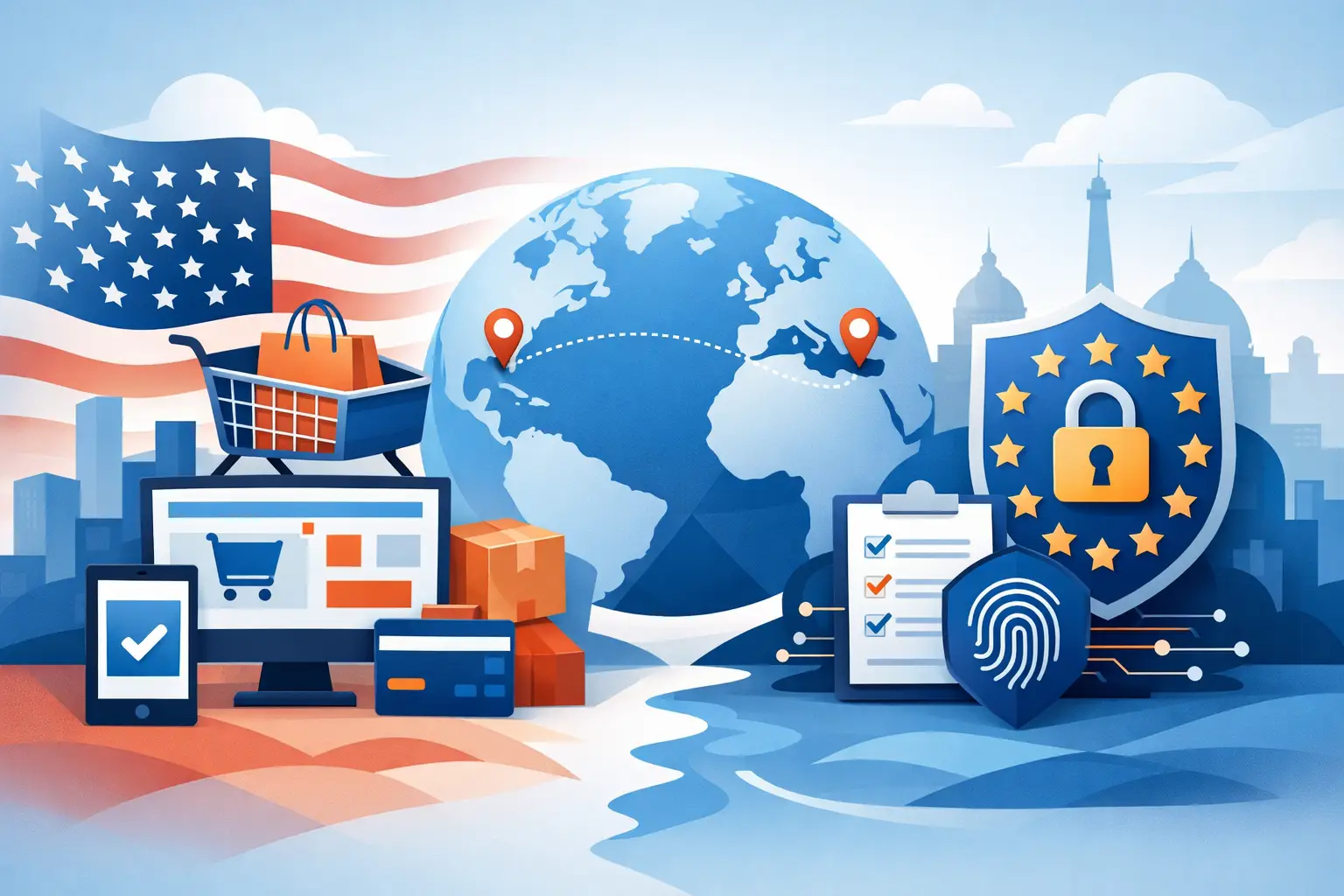
A US store does not need a warehouse in Paris or a team in Berlin to create European regulatory risk. If your checkout accepts orders from France, your ads target shoppers in Spain, or your analytics track visitors in Germany, your american ecommerce gdpr exposure may already be live.
That exposure is not theoretical. It shows up in procurement reviews, customer privacy complaints, regulator-facing gaps, and one especially visible failure point - not appointing an EU representative when Article 27 requires one. For US ecommerce operators, the problem is usually not bad intent. It is false assumptions. Many teams still believe GDPR only matters if they have a physical EU office, large EU revenue, or a company incorporated in Europe. None of those are the real threshold.
Where American ecommerce GDPR exposure actually starts
The first mistake is treating GDPR as a geography-of-business rule. It is more accurately a geography-of-people rule. If your business processes personal data of people in the EU in connection with offering goods or services to them, or monitoring their behavior, GDPR can apply even if your company is fully American.
For ecommerce, offering goods or services is often easy to spot. You ship to EU countries, show prices in euros, mention delivery to the Netherlands or Italy, run paid campaigns aimed at EU audiences, or localize your site for European buyers. Any one of those facts can become evidence that you are intentionally serving the EU market.
Monitoring behavior can be broader than many commerce teams expect. Retargeting pixels, ad attribution tools, session replay, behavioral profiling, and analytics tied to individual users can all push a business deeper into GDPR territory. Plenty of US brands assume they are just measuring performance. Regulators may see tracking of EU individuals.
The hidden Article 27 gap in American ecommerce GDPR exposure
Once GDPR applies, the next question is whether you need an EU representative under Article 27. For many non-EU ecommerce businesses, the answer is yes.
Article 27 generally requires a company with no EU establishment to appoint a representative in the EU when it falls under GDPR's territorial scope, unless a narrow exception applies. That exception is often misunderstood and overused. Businesses sometimes point to low order volume or limited European marketing and assume they are exempt. But the exemption is not a casual small-business pass. It depends on processing being occasional, low-risk, and not involving special categories of data or criminal offense data on a non-occasional basis. A functioning ecommerce operation with repeat EU sales, ongoing customer accounts, routine analytics, and lifecycle marketing often struggles to fit that standard.
This is where exposure becomes visible. Your privacy notice should identify your EU representative if Article 27 applies. If it does not, that omission can be obvious to regulators, counterparties, and privacy-aware customers. In practical terms, this is one of the easiest compliance gaps for an outsider to spot.
Why US ecommerce teams underestimate the risk
American companies often map privacy risk through a US lens. They look for lawsuits, state attorney general actions, or headline fines against giant tech companies. GDPR exposure in ecommerce is different. It can begin with smaller operational pressure points long before a major enforcement event.
An EU customer may ask where your representative is. A corporate buyer may flag the issue during vendor onboarding. A supervisory authority may contact you about a complaint or a missing disclosure. Your team then has to answer a European legal question without a local legal foothold, without a designated contact structure, and sometimes without clarity on which member state relationship matters most.
The commercial damage can arrive first. Deals slow down. Procurement asks follow-up questions your team cannot answer cleanly. Internal counsel has to rush a fix. Marketing keeps selling into Europe while compliance is visibly incomplete. The issue stops being a privacy footnote and becomes a revenue and credibility problem.
Common trigger scenarios for US online sellers
Most american ecommerce gdpr exposure starts in ordinary growth decisions, not dramatic expansion plans. A Shopify brand opens shipping to ten EU countries. A DTC operator launches Meta campaigns to audiences in Ireland and Germany. A subscription business starts charging VAT-inclusive prices to European customers. A wellness brand adds Klaviyo flows, behavioral segmentation, and cart-abandonment tracking for EU visitors.
None of these steps look unusual to a growth team. Taken together, they show intentional market access and continuous data processing involving EU individuals. That is exactly why legal exposure is often created by marketing, product, and operations long before anyone asks legal to review the model.
There is also a timing problem. By the time a business starts getting meaningful EU revenue, it may already have months or years of uncovered activity behind it. The gap is rarely that the company ignored privacy entirely. The gap is that it handled GDPR like a policy-writing exercise instead of an operational requirement.
What regulators and counterparties will look for
They will not start by asking whether your intentions were good. They will look for visible signs that your compliance structure is real.
That includes whether your privacy notice reflects GDPR applicability, whether you identified a lawful basis framework, whether your cookie and tracking practices align with EU expectations, and whether an Article 27 representative has been formally appointed where required. They will also care whether data subject requests and authority inquiries are routed somewhere competent.
This last point matters. A mailbox service gives you an address. It does not give you legal judgment, coordinated response handling, or confidence that a regulatory inquiry will be triaged correctly. For businesses facing actual exposure, that difference is not cosmetic. It is the line between passive forwarding and active representation.
How to assess your exposure quickly
Start with your customer reality, not your corporate structure. Ask whether you intentionally sell to EU residents, whether you ship there, whether your store references EU markets, and whether your ad stack or analytics tools track EU users. Then ask whether that processing is occasional in any honest sense. For most established ecommerce businesses with recurring sales and standard martech workflows, the answer is no.
Next, review your privacy notice. If GDPR applies, does it say so in a way that matches your actual operations? If Article 27 likely applies, is your EU representative identified clearly? If not, your compliance gap is public.
Then examine your operating model for response readiness. If an EU data subject objects to processing, requests deletion, or questions your legal basis, who handles that? If an authority contacts you, who receives and evaluates the request? If the answer is a shared inbox and internal scrambling, your exposure is not under control.
What reducing exposure looks like in practice
Reducing risk does not always require building a full European legal function. But it does require treating Article 27 and related GDPR obligations as live infrastructure.
For many US businesses, the first practical fix is appointing a qualified EU representative with real legal capability behind the role. That means formal designation documentation, publication details for your privacy notice, and a contact point prepared to handle inquiries rather than merely relay them.
The second fix is aligning your external disclosures with your actual processing. If your site targets the EU, say so accurately. If you rely on tracking, assess whether your consent and transparency model fits. If you process recurring order, account, and marketing data from EU customers, document that reality honestly.
The third fix is operational readiness. Your team should know how data subject requests are triaged, who owns incident escalation, and how authority communications are handled. This is where a lawyer-led representative model is materially different from commodity coverage. A serious representative helps absorb pressure, organize response, and reduce the chance that a manageable issue turns into a mishandled one.
For companies that need to close the gap quickly, services such as rep4eu exist because the market has learned a hard lesson: visible non-compliance is expensive, and fake coverage is not coverage.
The real business test
The cleanest way to think about this issue is simple. If an EU customer, enterprise buyer, or regulator looked at your current setup today, would it appear that your business understands and can meet its obligations? Or would it look like Europe became a revenue channel before it became a compliance decision?
That is the heart of american ecommerce gdpr exposure. It is not just about whether a fine might happen. It is about whether your business can keep selling into Europe without carrying a visible legal weakness that others can spot before you do.
The smart move is not panic. It is speed with substance. Fix the public gap, put real representation in place where required, and make sure the next privacy question that reaches your business lands on someone equipped to answer it.