

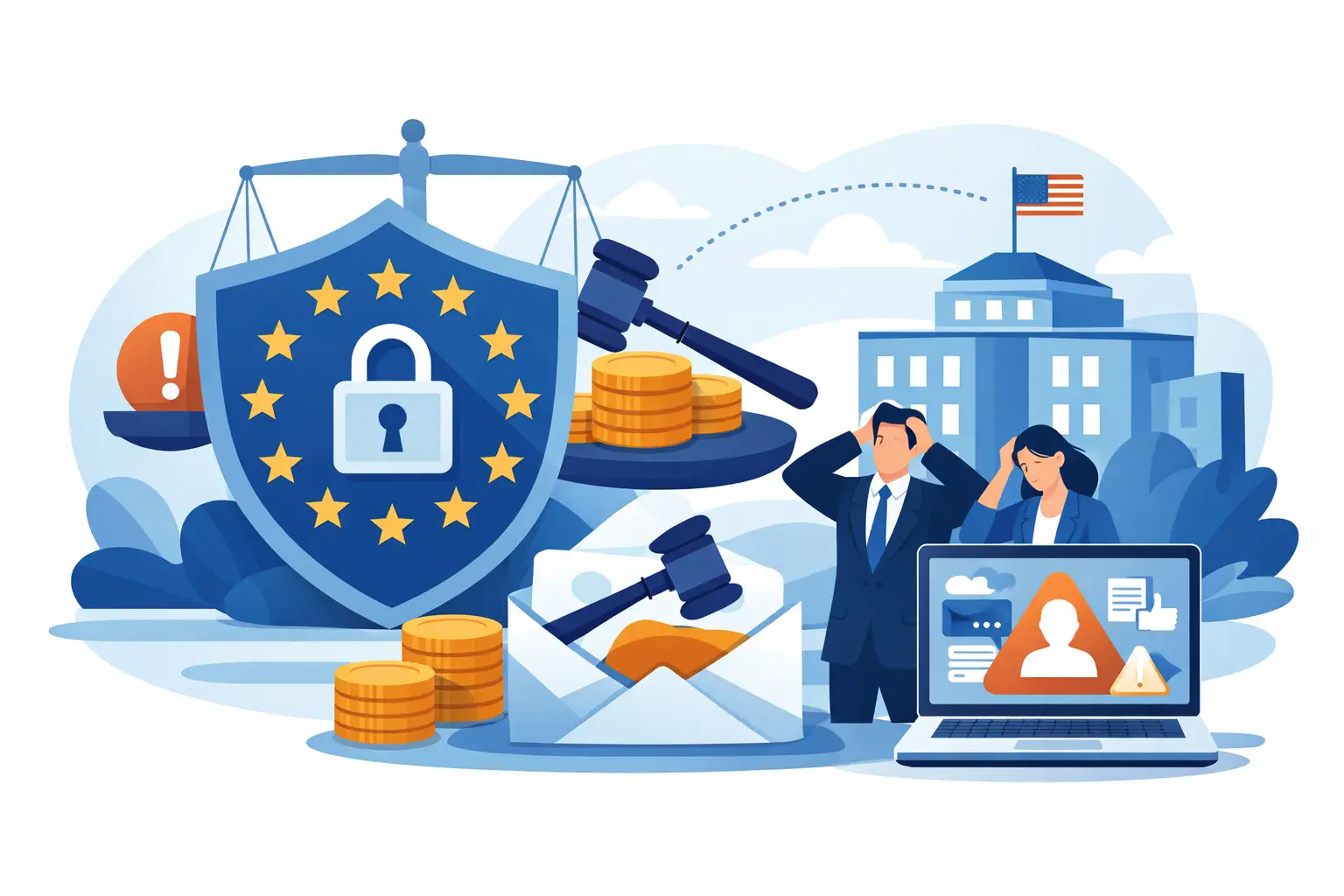
A US company does not need an office in Paris, Berlin, or Amsterdam to face GDPR enforcement. If it sells to people in the EU, markets to them, or tracks how they behave online, GDPR fines for US companies are a live business risk - not a European legal issue that can be ignored from across the Atlantic.
The first problem is often not a dramatic breach. It is a visible compliance gap: no valid privacy notice, no lawful basis for tracking, unanswered access requests, or no EU representative listed where one is required. Those gaps give regulators, enterprise customers, and privacy-conscious users a clear reason to question whether your company is prepared to handle EU personal data at all.
When the GDPR Applies to a US Company
The GDPR can apply to a company with no EU entity under Article 3(2). The test is practical. Are you offering goods or services to individuals in the EU, or monitoring their behavior there?
A SaaS company that accepts EU customers, prices in euros, runs EU-targeted campaigns, and provides localized onboarding is likely offering services to people in the Union. So is an ecommerce brand shipping to EU addresses. An app that profiles EU users for advertising, analytics, fraud prevention, or behavioral personalization may be monitoring behavior.
Nationality is not the point. Location is. A US business processing the data of a person who is in the EU can fall within scope even if that person is not an EU citizen.
There is no safe rule that says a company is exempt because it is small, has only a handful of EU users, or has no physical presence in Europe. Those facts can affect risk and regulatory priorities, but they do not automatically remove the GDPR's reach.
How Large Can GDPR Fines for US Companies Be?
The headline maximum under the GDPR is up to €20 million or 4% of total worldwide annual turnover from the preceding financial year, whichever is higher. This upper tier can apply to serious violations involving core principles, lawful processing, data subject rights, and certain international data transfer obligations.
A lower tier can still reach €10 million or 2% of worldwide annual turnover. That tier covers several operational requirements, including failures connected to Article 27 EU representative obligations. For a growth-stage company, either figure can be commercially disruptive. For a large company, the worldwide-turnover calculation means GDPR exposure cannot be treated as a minor regional cost.
Maximums are not automatic. Supervisory authorities assess the nature, gravity, and duration of the violation; the number of affected people; the categories of data involved; whether the conduct was intentional or negligent; prior violations; mitigation; and cooperation with the authority. A company that can show documented controls, a credible response process, and prompt remediation is in a materially stronger position than one that cannot explain who owns privacy compliance.
But waiting for a fine is the wrong planning horizon. Regulatory inquiries consume executive time, legal budget, engineering capacity, and customer confidence long before a final penalty arrives.
The Failures Regulators Can Actually See
Many companies think enforcement begins with a sophisticated cyberattack. Breaches certainly create exposure, particularly where security failures or delayed notifications are involved. Yet routine operations often expose a company first.
A user sends a deletion request and receives no answer. A prospect discovers that the company has no EU representative details in its privacy notice. A supervisory authority sends a letter to a US headquarters and receives silence, delay, or an incomplete response. An enterprise procurement team asks how EU data subject requests are handled, and nobody can provide a clear workflow.
These are not theoretical problems. They are evidence that privacy obligations have not been operationalized.
Common pressure points include:
- Collecting more data than the product genuinely needs, or retaining it indefinitely.
- Using cookies, pixels, and advertising tools without a valid consent and disclosure framework.
- Failing to document a lawful basis for processing customer, prospect, employee, or user data.
- Ignoring access, deletion, objection, or portability requests, which generally require a response within one month.
- Transferring personal data outside the EU without an appropriate transfer mechanism and supporting safeguards.
- Treating a security incident as an internal IT issue rather than assessing whether GDPR notification duties are triggered.
The legal details depend on the processing activity, the countries involved, and the role of each vendor. The business lesson is simpler: regulators expect a company that targets the EU to be reachable, organized, and able to answer for its data practices.
Article 27 Is a High-Visibility Compliance Gap
For many US companies, Article 27 is the obligation that turns abstract GDPR risk into an obvious deficiency. A non-EU organization subject to the GDPR generally must designate an EU representative in writing unless a narrow exception applies.
The exception is not a casual small-business exemption. It is limited to processing that is occasional, unlikely to create a risk to individuals' rights and freedoms, and does not involve large-scale processing of special-category data or criminal-offense data. A SaaS platform with ongoing EU users, an online store with regular EU sales, or an ad-supported app with persistent analytics will often struggle to fit that description.
An EU representative is not merely an address to place in a privacy policy. The representative serves as a contact point for supervisory authorities and data subjects on GDPR matters. If a regulator reaches out, a passive mailbox provider that only forwards a message leaves your business with the same operational weakness, just one step later.
A lawyer-led representative can receive, triage, and coordinate the response with the company. That does not erase the controller's or processor's obligations, and it does not guarantee a regulator will take no action. It does mean the first contact is handled by someone who understands what the authority is asking, what deadlines matter, and what should not be improvised.
What Reduces Enforcement Risk Before a Complaint Arrives
The strongest defense is not a generic policy copied from a competitor. It is a compliance structure that matches your actual data flows and can be demonstrated when challenged.
Start by mapping what personal data you collect from EU individuals, why you collect it, where it goes, who can access it, and how long you retain it. Include product databases, CRM systems, support platforms, analytics tools, payment providers, advertising technology, and internal collaboration tools. Most blind spots sit with vendors and secondary systems, not the main customer database.
Then test the public-facing layer against reality. Your privacy notice should accurately identify the relevant entity, explain purposes and legal bases, address international transfers where applicable, and provide a workable route for privacy requests. If Article 27 applies, list the representative's details. A notice that overpromises or names a contact that cannot respond creates its own credibility problem.
Next, establish ownership. Someone must be able to receive a request, verify the requester where appropriate, gather data from systems, decide whether an exception applies, and respond on time. The same discipline applies to incidents. Your team should know who assesses a suspected breach, who preserves facts, who directs legal review, and who decides whether a notification is required.
Finally, appoint an EU representative where required before a regulator, customer, or complainant identifies the omission. rep4eu provides Article 27 representation through licensed German attorneys, not a simple forwarding address. For companies that need EU coverage without creating an EU subsidiary, that distinction matters when an authority inquiry or data subject request needs a substantive response.
Do Not Treat a Fine as the Only Cost
A GDPR penalty is the clearest number on a risk register, but it is rarely the only cost. EU prospects may pause procurement when your privacy documentation is incomplete. Existing customers may require contract amendments, security questionnaires, and proof of representation. A public complaint can create reputational damage that far exceeds the direct administrative fine.
There is also a practical cross-border issue. A regulator does not need to wait for a US company to become easier to reach. The GDPR's extraterritorial scope is designed for businesses that engage EU markets without an EU establishment. If you benefit from those markets, build the compliance capability to answer for your conduct there.
The useful question is not whether your company is large enough to make headlines. It is whether, if an EU customer or authority contacted you tomorrow, you could respond clearly, lawfully, and on time. If the answer is uncertain, that is the gap to close now.